Tuesday, 7 July 2015

Bosnia and Herzegovina

We are getting used to border crossings and were ready for a smooth transit out of Montenegro and into Bosnia. The right hand drive vehicle helped this time, as the border officer took one look at Dawn sitting there without a steering wheel to lean on (or it might have been the distinctive EU standard issue passports) and he waved us straight-on through.

Unlike other crossings, we then drove through an extended no-man's land which included a planked bridge over a river with white water rafters on the water below.


Then we were at the BiH border and the officials there (at least three), said "British" and waved us on. However we weren't ready to go without a fight as we needed insurance. The usual "Green card" was this time met with arm waving, head shaking (or is it nodding, I can't get it right in the Balkans) and they pointed back through NML and said "Insurance Montenegro".

So we turned around, drove back over the planked bridge and stopped on the entry side and knocked on a window. There was no reply, even though I could see people in the room. So I knocked on the door and went in. Before I could speak it was made clear that I was interrupting lunchtime as they pointed to the food on their plates.

Now I have rarely been "at lunch" in my career, in fact at the Jet project at Culham in the late eighties, I gave a guy much older then me a bit of an earful when he insisted he was "at lunch". I didn't think that would be wise this time, so instead I walked over to the Montenegro-exit window and the guy pointed back up the hill.

100m into Montenegro is where all those people rafting were assembling and we drove up and pulled in, conveniently between two Defenders. People got interested in ours and once we had compared engines, we managed to explain that we needed insurance.

I was taken to a random cafe, over which was a guy in an office. He wouldn't open the door but he did respond to a shout (a bit like the guy at Jet) and came to ask what I wanted. Ten minutes later I was €30 lighter and had third party car insurance to cover me for three days in Bosnia and Herzegovina.

All that remained was to go back through the exit gate, over the plank... and we were into Bosnia. New territory!


There's another sign at the border which I was surprised to see. It's for the Republika Srpska, recognised by the EU in 1992 as independent from Bosnia and Herzegovina. A former President is Radavan Karadžić and the Chief of Staff of the Army then was Ratko Mladić, names people will remember with some significance. The Republic is now one of the two main political territories of Bosnia and Herzegovina.


The road on the Bosnian side was more suited to Land Rovers than normal cars and it continued like this for about thirty minutes. As we were to find, this isn't typical of BiH roads, although it made us wonder just what were we doing there as we drove from the border.


The reason for going to the country was to visit Sarajevo and Mostar. Everyone of our generation and older, will remember the Yougoslav wars, perhaps especially the war in Bosnia and the siege of Sarajevo. This terrible ordeal lasted from 1992 to 1996 and my memories have been reinforced by reading "The Cellist of Sarajevo" by Stephen Galloway, in which references to the tunnel under the airport, sniper alley and the snipers in the hills, all brought back those memories. It's also the twentieth year since the Srebrenica massacre.

We decided that camping overnight wouldn't be the most suitable option and instead made an advanced booking at the guest house that came top of the Trip Advisor list. The Halvat guesthouse has five rooms and is fantastically convieniently situated in the Old Town and so we would therefore need to drive into the middle of the city.

The people of Sarajevo have been repairing and rebuilding since the war ended and it's a beautiful place but still with a few signs of the conflict. This building is on Sniper Alley, the road from the airport into the city.


This block still shows bullet holes and shrapnel marks.


This however is City Hall, once the home of the National Library, which was all but destroyed through deliberate targeting and 90% of the contents were lost in the fire.
It has been totally rebuilt; I believe it was completed last year.


This is "that bridge", which rather surprisingly, wasn't much of a focus. This is the place at which the heir to the throne, Archduke Ferdinand, was assassinated during a tour of the city. This was the trigger that started the First World War.


As we walked through Old Town, the hills were very close. It's easy to see why the people in the city were easy prey for the snipers up there.


We had a lovely breakfast at a café called "To Be or Not To Be" and talked to the owner about the war. In spite of the fact that she had for sale, a poster featuring 'The Cellist', she told us that she had remained in the city throughout the siege, but that she preferred now not to think about it - not for the fears particularly, more because she simply wanted to move on.


She makes a mean omelette by the way, Dawn was impressed too. Much as we engaged her in conversation, she never let slip her "secret ingredient" that made it so tasty.

It's Ramadan and as we were staying in Old Town which is full of Ottoman influence, it was noticable that very few people were eating during the evening. It wasn't until 21:45 or so that we heard the sound of a cannon that marked the end of the fast and the beginning of the meal, Iftar.

We had already walked past a shop with a long queue of people all buying what in England would have been fish and chips. They were walking away with a paper bag full of some foodstuff. We later learnt that they were buying Somun and that queuing towards the end of the fast and embracing the smell of the bakery, is all part of the end of the day ritual. It seems that Somun is made with a dough including yeast, baked for two minutes in a wood-fired oven. I'm sure it's delicious, especially if you haven't eaten since sunrise.

Sarajevo was a lovely city and as with many places, we could have stayed there to soak up the atmosphere; but what do you do? So we went to Mostar.


We camped at a little place just a few kms south east which was memorable in its own way. The little village of Blagaj has a Dervish house, a fort on an inaccessible hill (too steep for us anyway) and a river sourced from a spring within the rock wall under the castle. This spring flows at a rate of 43m3 per minute (43,000 litres if that's easier to relate to).

The campsite is right next to the river just a km downstream. That evening we were subject to an extreme change in temperature. It had been well over 30C during the day, yet as soon as the sun went down, the water temperature become noticeable as it was at 8-10C. By mid evening it was really cold sitting by the tent. If you've ever stood on or close to a glacier in summer , it's a similar sensation. 
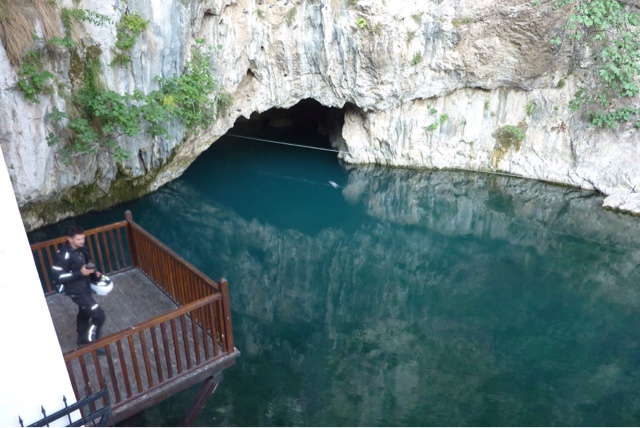


I could read-up about what a Dervish house is and then write about it, as if I knew all along, but I haven't and this is left to the reader as homework. As a clue, this is how Dawn was required to dress in order to walk around.


As well as a ruined castle, the village bears scars from the more recent conflict.


It really feels odd when you see scars like these that have happened just a few years ago.

Mostar is another city that everyone remembers, not least because its iconic bridge was destroyed in the conflict, only to be rebuilt, starting in 1997 under guidance of UNESCO with money from various countries, including Italy. It's now one of the UNESCO World Heritage sites.


We spent ages talking to one of the real metalworkers in the town. Most of them are half heartedly tapping away to show off some slightly tacky metal souvenir. When I walked into this particular workshop it was clear that it was something special. I now know how to punch a copper/silver plate (obtained from Bosnian gypsies apparently), in order to produce a raised image. When I also found out how long it took the expert to make one, I realised that I wouldn't be buying one to take home. Sorry Mostar.


More war scars.


After our experiences with Mike the Greek a few weeks ago, you would have thought that we would not let the market traders get the better of us. This lady was far more brazen than Mike our NATO seller at Epidavros. She waited till we had chosen all that we wanted, telling us it was all "dobra", then took the bags and started to stuff other goodies into them. However, she ensured that she weighed them too!


It was when Dawn hesitated in front of the old man selling fruit brandies, that things got a little out of hand. The more samples she tried, the happier they both became!


It was very hot in Mostar. It's only 45m above sea level so there's no cooling through elevation. It's too far from the sea to get any obvious relief that way. During our visit it was 35C, but we were lucky as a few days later it was 39.




Saturday, 4 July 2015

Mountains of Crna Gora and cheese

We chose to drive through the centre of Crna Gora, known to us as Montenegro ((Black Mountain), so that we could visit the Durmitor National Park. A first visit would usually include the coast south of Dubrovnik, which we have already visited (Kotor etc.). A guy at a filling station was overjoyed to hear that this wasn't our first visit to his country. He even knew that GB on the plates meant Great Britain!

At the border all was fine until the Montenegro barrier side, where we asked for the "green card". This is a universal phrase at the borders, even though there is no such physical thing as a green card anymore (not in these parts anyway). I was directed to the fourth window around the corner and there I met the border lounge lizard.

He was a little surprised to see me, so the TV screen he was watching with his feet up on the desk was clearly not the cctv of the border office.

"Can I have a green card please?".
"Green card?".
"Yes please, a Green Card".
"Car documents".

So I handed over my V5 and waited for the sharp intake of breath as he found the 'B' vehicle classification or some other reason to charge excessively.

"What vehicle?"
" Land Rover - it's a normal Land Rover".
"A normal Land Rover. Seats?"
"No, yes well two - it's for camping".
"Camping car?".
"No, just a big space inside".

Then he did an amazing thing, he swung off his chair and came outside to look around the corner at the Landy. ( only from the rear and from a distance). Then he was back in the office, pulled a piece of paper and filled-in the details, and charged me €15.

So we were "in" with 3rd party insurance.

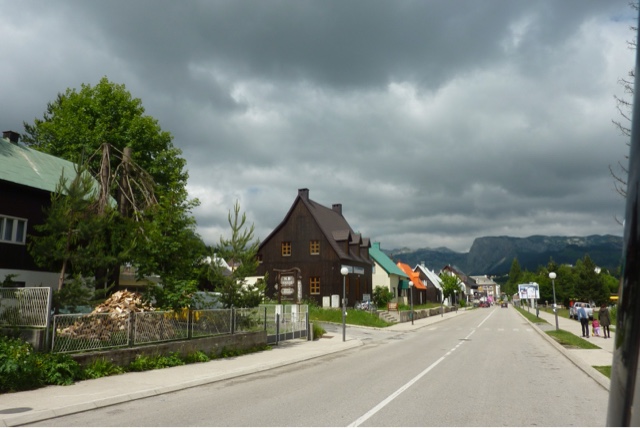
We headed north and skirted Podgoriča and to Durmitor NP. On the top of a large high plain and nested under the highest peak, is Žabljak, which looks as though it should be in Scandinavia.


We stayed at a small campsite just outside the village, with a view of the mountain. That was, until the clouds rolled in and the heavens opened. It was just like a wet night in the Lake District. As we were at 1,400m or so, it was cold and the rain was very wet. I was thankful that as usual when pitching the tent, I hadn't taken any short cuts and I had 'pitched for the worst'. On the continent you just don't seem to get the warning about when the rain is going to start. Suddenly it's coming down.

The morning was cold and clear.


Our route through the mountains was a high pass, over 1,900m, round the back of Bobotov Kuk in the picture, which at 2,523m is the highest of the Durmitor peaks. There are forty eight of them that are above 2,000m. Amazing!

It's a narrow road but easy driving, just a lot of hairpins.


Once we had got our fill of the views from the top of the pass, we jumped back in the Landy, ready for the next section which is a high level road through the mountains. As we drove down from the pass there was a sign at the roadside and we could see a small collection of buildings beautifully situated on a grassy shelf.

It was a rough grassy track and we've got a Landy, so we launched across it to see what the signs were all about.


Meet the family! Oorosh, his wife Rada, son Vacilli and daughters Danistar and Maria. (Excuse the phonetic spelling). The next hour was a lovely experience during which we got to know a little about their summer way of life.


For twenty years this couple have come to live up here during the three summer months, following in the footsteps of Rada's parents, who did it for sixty years. They bring with them animals and essentials and run this small holding and make cheese, fatten turkeys and generally have an amazing time.

We spoke in broken English with mum and daughter number one, who by the way is no slouch. She has a first degree in Civil Engineering and is studying for her Masters, specialising in railway track routing and foundations. The other kids are at school but are happy that their holiday is spent up in the mountain, tucked just beneath the 1,907m pass.

Inside the timber house (a Koliba), Rada gave us cheese to taste, made with milk from the handful of cows which are no doubt milked by hand every day. There were various flavours, including a cream cheese which tasted lovely. They have some refrigeration, I think driven from a generator. We have cooling driven from a battery so we couldn't go overboard in our purchases but we managed to buy two cartons which we ate at lunchtime (and gave us garlic breath) for several days.


It really was a wrench to leave; I could have stayed there for the rest of the summer especially as Dad and Son were constructing another Koliba. However they probably wouldn't have welcomed the intrusion for any longer so we made our way back to the road.

At the next pass, we were contemplating the view and solitude once again, whilst watching a truck make its way towards us. Just after it passed, there was the sound of several car horns as it passed one, two, three... vehicles. Sounding your horn is usual but more than a dozen times is not.

In fact about fifty people got out of about twenty cars, which all stopped next to us. We should not have been surprised to know that this was a group trip of some sort. We were surprised to find that it was a dance troupe from Chicago, comprising third generation Serbs, who were touring the Balkans and performing their act. They had their fourth generation kids with them who were learning the Serbian language and generally developing the knowledge of their Serbian roots.


We exchanged lots of views of Durmitor and Land Rovers and my bonnet (hood) was raised and the 300TDi engine was 'wowed' over.

Then they were gone and we continued north, still on the single track road, heading for a lake in a gorge, where we would pickup the main road.

After many kms, we reached the lake, as the satnav map showed it right next to us, but I got the shock of my life when I finally spotted it below me.


It was directly below us, right there under the wheels (as well as further over, as this pic shows). It was impossible to understand how we could get down to a road that is on our side of the water. This was how, about a dozen tunnels, some of which are on hairpin bends. In the pic below you can se the entry and exit.


After the steep descent and plenty of dark tunnels ( no lights here and they are tunnels, carved from the rock without concrete linings), we got down to the lake, which is actually a reservoir. Later in the day we would drive through a tunnel that was 2,200m long, with no lights and no markers. It was very dark and very scary.


The scenery was still stunning and that is our everlasting view of Crna Gora, an amazingly beautiful country, full of mountains and gorges.

It was a shame to leave!


Wednesday, 1 July 2015

More Albanian cultural sights and more mountains

We got our fix of beach life, Albanian Riviera style, for three nights and it was a very relaxing time. The beach taverna served simple dishes and we had grilled fish twice. Another taverna 300m along the dusty track was a little more up market and we had a nice meal there. It is very cheap to eat out and there's no reason why we should cook our own and anyway, finding a suitable shop is a challenge in these small places.

So we left Dennis and the other beachside campsites, who were all gearing up for the busier few weeks ahead and drove north along the coast a few kms and then inland to the old town of Berat. The climb away from the coastline was another set of spectacular hairpins. That's the road on the hillside.


The campsite at Berat was very small but with great shade and very good toilet and shower facilities This makes camping a great experience. There was a typical seasonal sight behind the site:


This is straw, baled mechanically but with the bales gathered by sets of two legs and pulled by four legs. Across Albania we saw many scythes in use for the cutting of grass for hay, some powered mowers were also seen, but almost all the turning and rowing-up of the hay was being done by hand.


Berat is a Unesco World Heritage site, "city of a thousand windows". It is dominated by a huge mountain, Mount Tomorri and by a large craggy outcrop. The old town of Ottoman style buildings, clings to a very steep cliff and on top of the rocky outcrop is a sprawling castle.

There's a river flowing alongside the town and a pedestrian suspension bridge. Even in June, the river has a reasonable flow. As we sat in a cafe above the river we saw a shepherd approach the riverbank, followed by a small flock of sheep. On reaching the bank he ensured that they got down to the water, then he climbed back and walked over the bridge, whilst the sheep waded through the water. At the other side, the two met and continued their slow walk to wherever. What amazing sheep; Derbyshire sheep aren't so well behaved. They certainly don't 'follow' and instead they are 'driven'.


Whilst we wandered the streets inside the walls of Berat Castle which is a village itself really (and it's easy to get lost as it is a real warren),  we said hello to a young guy who emerged from a door. Behind him was a group of boys of varying ages, all dressed in their favourite football shirt. Meet the Berat All Stars, under 11s (and over 2). As soon as they realised there was a 'foto', they assumed this pose. It was amazing to see them do it. Perfect.


At the Berat campsite there were only four other tourists, including a young couple from Oz who had worked the winter in a French ski resort, then bought a Dutch licenced camper off eBay and somehow got it registered and insured for a trip around Europe.

There was also a 'mature' couple from Germany in this:


...which is a flat-bed truck carrying a small container that has been opened-up into some form of camper. When I look at big vehicles like this I really don't know what to think. There's no way I could have got it through one or two village centres as the roads just weren't wide enough and on exposed mountain roads they must have a lot of nerve to drive on the edge.

We 'hit' Berat on Friday evening and joined the Albanian version of evening walkabout. I think I may have mentioned passagiata before; it's a beautiful sight to see. I wish the UK weather was more suitable for this social occasion.


It actually hadn't really got started when these pics were taken.


Lake Shkodra is in the north west of Albania and it's here that the border with Montenegro can be found. It's very near to the coast but is a freshwater lake and it's quite a size. The campsite www.lakeshkodraresort.com was recommended by people we had met further south and indeed it is a nice one. It's about a mile down a track and is huge with an open space through the middle. There's a good campsite restaurant serving great food and there's access to the lake, although it's quite shallow for swimming.


The mountain across the lake is a little bit of both countries; to the left is Albania and right it's Montenegro, although there isn't a connecting road. It's marked on our map as Mt. Golishit, a rather unappealing name I think.


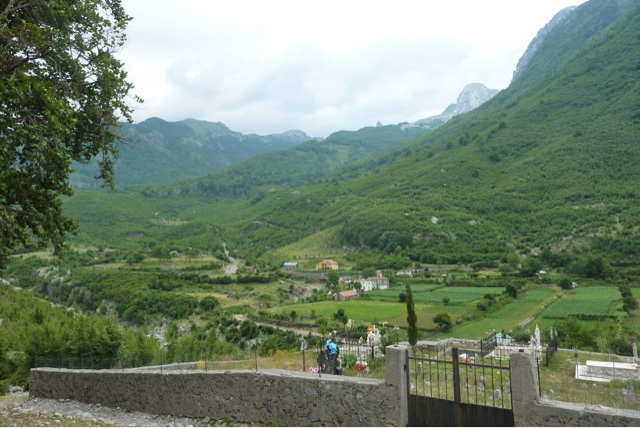
From here there are nearby very high mountains, the highest are around 2,500m. These are known as 'The Accursed Mountains' and with some trepidation, we decided to explore by driving up into a valley, across a pass, to see if we could get to a village called Theth.


The road at the top of the valley has been rebuilt with EU funds ( there's plenty of those projects around) but then it's a stony track for a few hundred metres to, surprisingly, a café.

Even more surprisingly a few wedding guests were assembling for what was going to be a photo shoot. So we gave the page boy some practice, which he wasn't too keen on but his dad was happy.


Then the bridge and groom arrived ( don't forget it's about 1,900m here).


On one shot the Groom had to "implore"... Is that the correct word?


We continued on the single track unmade "road" for a couple of kms. We would need to turn around at Theth, but well before there, SWMBO made an executive decision and forced an early turnaround, due to extreme nervousness that a photo can't reproduce. It was a multipoint turn, executed in the safest spot I could find. The problem was excessive exposure to the drop-off at the side of the road (and I tend to agree that it was a bit dodgy), in spite of the fact that the Albanians don't seem to have a care. In fact they have a Furgon (minibus service) up to Theth, but that must be even more scary (or maybe we wimped out).


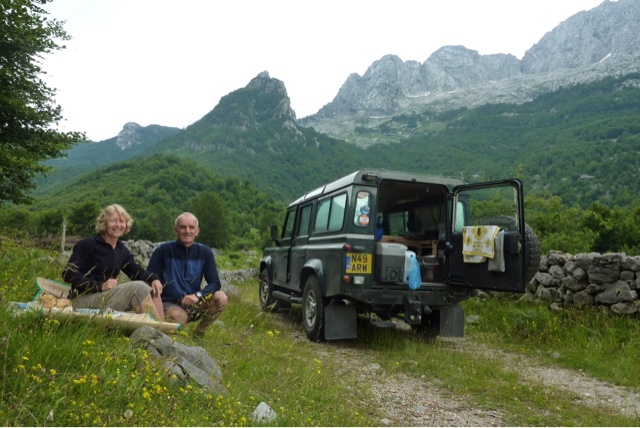
We were relieved to get to the asphalt and had a relaxing picnic in a very quiet spot.


I can't finish this post without mentioning the Enver Hoxha bunkers. We had read that thousands had been built in order to provide each citizen with a tank-proof place to shelter in during conflict. Of course conflict never came, however these concrete structures have taken a long time to fall into disrepair or be removed. They look like the top of a Darlek and although we saw quite a number of them, there's nothing like the huge quantity that the guidebooks suggest. Someone is removing them quickly although this one has found a new lease of life as a café.


So, what are our final impressions of Albania? We liked the scenery and the Albanian people could not be more friendly and welcoming. An advantage for us Brits particularly, was that everyone wanted to speak to us in English, ask us where we come from and occasionally link this to some knowledge of the UK.

For example, our BnB hosts at Gjirocaster told us that their daughter had attended university in Newcastle and they were so grateful "that Newcastle gave her the chance". She now works in "a good job in Tirana", "but married an American boy and we can't afford to travel there. Why not an English, the airfare is much lower?"!

We think that whilst Albania is scenic, but it's not as attractive as Greece simply because there's little village life. Outside of the towns like Gjirocaster and Berat, the developments don't have a centre. There's no focus on the church or the market place. Houses tend to be built in a continuous sprawl. Maybe this is because they are small holdings or farms. It does appear that all the houses have a small bit of land around them. We frequently saw men walking a single cow, so life is very 'simple' in places.

So whilst the mountains are high and the beaches stunning, there isn't the lovely sense of community that you get walking into a Greek village. We missed that!

There are plenty of slights that we have also missed in Albania. We didn't visit Lake Orchid and didn't take the ferry from Koman to go to Fierza and Valbone. So there's plenty left!

So from Lake Shkodër we drove a few kms north and we crossed the border into Montenegro.