Tuesday, 23 June 2015

Lefkas and a scary mountain drive

We decided to try a couple of days on the Ionian coast and all reports suggested the island of Lefkas, an island connected to the mainland with an isthmus.

It was the end of a long drive from our wild camp in the Peloponnese and it was quite late by the time that we crossed the small bridge and drove along to the main town. This is clearly a yachting mecca.


We made a run for the western coast, only to get there and find that the campsite we had chosen isn't on the beach and that just won't do.

A quick decision was made to head for the south-eastern town of Nidri and a site near there. We made a dash across the centre of the mountainous interior. "It can't be too difficult". Well most of it is around 1,000m and the roads are very steep. By the time we got down the other side, I'd had enough driving.

The campsite is directly onto the beach at one end of a small bay. It was worth the hard end to the drive.


There were motorhomes both big and small, with most having used the ferries from Italy to Patra. This is an extremely popular route into Greece and for Italians and Austrians particularly, it really makes it a short journey. You just factor-in the 24 hours or so on the ferry.

For motor home drivers it is very cheap - they don't need cabins and are allowed to sleep in their vehicle on the deck. So motor homes win again on the financial front. There is already a clear advantage in that they 'wild camp' wherever they want and it's mainly on harbour quays and in car parks. As they have on board sanitary and, of lesser importance water, they can of course pinch a site for free with zero impact.

I am conveniently forgetting here the initial capital cost of the vehicle, some of which will be £50-60K I'm sure.

We spent a couple of nice days on the beach, watching the Germans, Italians and Czechs playing with their inflatable speedboats. They were having a great time (and I was a little jealous).

However, Dawn's research required that we go north east to see some (more) monasteries. She mentioned something about them being perched on rocks. So we we off to an area called Meteora. First we had to get there and we picked an A road to take us on a southerly route east, knowing that we would use a more northern route to travel back west later in the week.

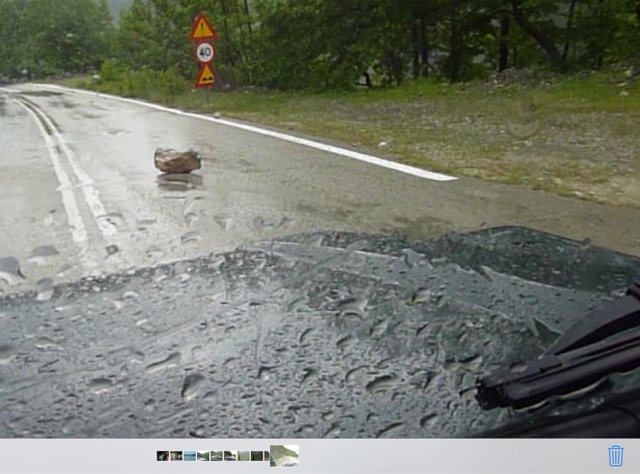
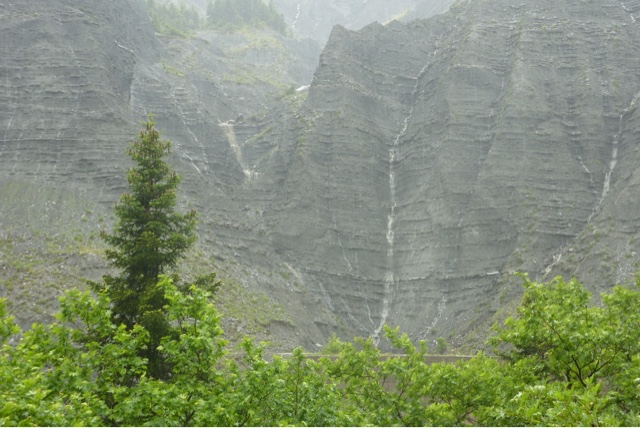
Now the photos that follow do not, in any way, convey the 45 minutes of rising panic and a little fear, as we crossed yet more mountains, particularly the stretch between Vourgareli and Stournareika. We timed it (im)perfectly with a thunderstorm behind, in front and above us.

I can deal with rain, even if the roof still leaks a little somewhere. The run-off onto the road was quite significant, but I've got big wheels and tyres. However, imagine Mam Tor and the unstable shales. Now multiply that by x10 in height and then imagine the drive is right under the face and it's about six miles. Water was pouring down the gullies and onto the road. The road was strewn with gravel, stones and rocks.


We could hardly manage to take photos as we were so worried about getting through, especially when we realised that the rocks were coming down onto the road as we were travelling.


It was with great relief that we passed through this area of great instability and I can honestly say that I've never seen anything like it. The mountainside was crumbling away as we looked at it. The local people must go to enormous lengths to maintain that road.

It wasn't quite over yet. A little further on we passed through a small village which had clearly been affected by an earthquake. Many buildings were abandoned and many of the remainder had corrugated sheet iron roofs. The road through the village (the same A road as before), had a series of quite awkward steps / cracks across, which were no trouble but still a first time experience.

As we completed the drive, the rain got heavier again and we hit a huge puddle of water in the middle of another village which appeared to be just a 'normal' big puddle. There must have been a problem with the road surface there too as it was very deep and the Landy ploughed straight in, aquaplaned and for a moment we were underwater, or so it seemed. It took an age for the windscreen to clear. Fortunately we had held our direction and came out unscathed.

At Kalambaka the tent was erected in double quick time but the bbq was half done when the next storm hit and food was eaten undercover with the help of a Wimbledon umbrella. We were a bit early with that advertisement, but so what!


Sunday, 21 June 2015

Wild camp in the central Peloponnese

It had to be done. There's something about being up high in the mountains and after a hot tour around Ancient Olympus, what better place is there to be than 'up there' in the cool?

We drove up through a series of lovely villages; this is one of them near the Althios Gorge:


As we drove high above the village we happened across a stony track and drove down about a half mile, past a small 'hymac' with a rock breaker attached that was half hidden in the bushes, only to be stopped by the sight of a distant gate. Clearly someone lived down there.

Reversing half way back, we noticed a narrow gap in the bushes and a quick recce showed that it was just possible to get the Landy a short distance off the track. There we found our perfect pitch for the night, hidden from all directions.


So it was all hands to the pumps to get a meal ready. This one is chicken with red peppers, courgette and aubergine. The small clearing had a metal lid which houses some sort of ancient water supply valve. It was a great base on which we sat Smokey Joe.


This is an appropriate time I think for a quick 'shout out' for Smokey Joe. This little chap is central to our holidays and has been for almost twenty years. He began life in Palatine, Illinois, in about 1996 or 1997' no-one can quite remember, but he emigrated very shortly after and came to the UK on a jet from Detroit disguised as a piece of luggage. Once through immigration, he was whisked away along the M4 to Cowbridge and has been part of our life ever since. He's been on every holiday involving a road trip since then and is used almost every day.

It's only fitting that he should feature in this self-timed exposure shot that perfectly illustrates this beautiful wild camp near Stemnitsa.


Now a note of caution to all those who still do washing-up in a bowl. There's nothing quite like the sense of triumph when the dishes are done and it's time to throw the water away. As we were up in the mountains, what little water there was in the bowl was ceremoniously thrown to the four winds in a sort of wide circular arc, across the bushes.

There's always a teaspoon in the bottom when you think you've finished, isn't there? Will this time it was one of two desert spoons. As a result of my carelessness, I am now forced to eat muesli with a fork!

The view in the morning was beautiful and as we were up with the lark, we had plenty of time to appreciate it.


The appreciation continued until about 8:20 when there was the unmistakable sound of a rock breaker operating. This is where Dawn and I differ in our interpretation of situations. I was worried that the rock breaker would be rock-breaking the track, up which we needed to drive to get to the road, whilst SWMBO was totalled chilled.

Of course we therefore continued to appreciate the view and slowly pack-up camp until finally it was  time to get back on the road. So it was 'wing mirrors retract' and back through the bushes and onto the stony track. As we drove up, to accompany the unmistakeable sound of a rock breaker, there was the unmistakable sight of a rockbreaker having unmistakably rock broken our route out!

But hey, this is Greece! Did the guy want to know who we were? Did he wonder what we had been doing down a private track? No. He heard me whistle ( too dangerous to get close), looked round and immediately folded the knuckle and spread the track back to something level enough for a Land Rover Defender to scramble over. He was so chilled he wasn't even impressed by the iconic vehicle that effortlessly drove by.

The rest of the morning drive was a continuation of high level driving, into the highest mountains of the Peloponnese, which are on the northern flank, adjacent to the shores of the Gulf of Corinth.

At the point where these mountains are the highest, there is a developing ski area ( Vathia Lakka), and also a gorge, in which a 40km narrow gauge railway snakes its way up and down to the Gulf, from the town of Kalavrita.


Nothing however, prepared us for the sense of 'drop-off' as we almost tipped over the edge of the mountains and began the steep descent to the Gulf. It is a stupendous road and half way down it got even better as we hit that important cultivation belt known as 'The Cherry Tree Belt' ( in the textbooks this is referred to as TCTB).  The Landy brakes were tested to the full as we passed a tempting roadside stall and we replenished our stocks, which had been severely depleted since that Albanian seller forced me to buy them at Neochorio, above Stoupa.

The sight of the waters of the Gulf was also a shock. I don't know what particles are suspended in them but they look like a Canadian Rockies postcard.


After a few weeks wandering through the Peloponnese, it was hard to adjust to the frenetic pace on the Athens to Patra motorway. It was very hot with a fast contra flow and dust from massive roadworks. On appeoaching Patra, we had a good view of the bridge which we would cross to take us to mainland Greece.


Friday, 19 June 2015

Ancient Olympus

From the west coast of the Peloponnese, we travelled inland just for an hour or so, to the site of Ancient Olympus.

We couldn't have picked a hotter day to visit. Having slept in the Landy under pine trees at a coastal camp site, we arrived at Olympus mid morning and luckily found a shady tree. This is really important as the food in the Landy would fry if exposed to sunlight. The silver foil bubble sheet that we put on the topside of the headlining is really working well. We also fit the window foils if there is any chance of sun striking the glass and these precautions have meant that the temperature isn't too high when we are stationary. Of course we have to keep the windows closed and the doors locked.

As for travelling, we don't have air-con of course (tee hee!) and we are now driving most of the time with both front windows fully open and the vents under the windscreen, wide-open too. These vents, the cause of so much angst amongst Land Rover drivers, are absolutely amazing when it comes to cool temperature drives. They direct outside air straight into the cab and it is lovely!

It has been fairly hot:-


So we were dodging the crowds at Ancient Olympus, which, once you are through the gate, are really spread out. Once again, as in Epidavros and Delphi, you can only stand amazed at the complexity of the remains, marvelling at the skills and endeavour of peoples so many centuries ago.

It's remarkable in scale and detail, with the buildings outside and the recovered statues, friezes, implements and other household goods, all on show in the museum.


It's the site of the original Olympic Games and it's here that the flame begins its journey to each new Games, although they must bring their own matches as there's no sign of an eternal flame.


Something intriguing caught my eye outside - it was a special information board:-


It provided me with extra interest as we walked the huge site. When I finally found what I was looking for, I could only wonder at what the 'technical reasons' might have been (answers on a post card please).


In the museum, we were careful when taking photos. Here's Dawn, not posing this time...


...but clearly distracted by something...


Another statue took pride of place in its own room.


This wonderful guy is Hermes of Praxiteles, the messenger of the Gods, charged with carrying the infant Dionysos to the Nymphs who would nurse him. The statue was carved at around 340 B.C. They say that he would have been holding a bunch of grapes, with the infant's outstretched arm trying to take some. Clearly all that's left now are a couple of plums.


The final finger of the Peloponnese

We spent almost a week in Stoupa and it's still our favourite seaside place. If I were Dutch or German I might think differently as it is a 'British' resort, mainly on account of the easy access to the airport at Kalamata and the two Thomas Cook flights each week arriving from Manchester and Gatwick. So that's two hundred or so Brits coming in on Sunday afternoons. Fortunately for the few Dutch and German visitors,  two hundred or so Brits also leave for the airport each Sunday morning. I've been one of those Brits several times in the past and probably will be again next year.

What makes Stoupa so special is its setting, small size and the crystal clear water of the bay, fed with cold fresh water to liven-up a swim.

This is the view down the coast towards Stoupa ( which is actually hidden, but in the middle distance). It's the view that the Thomas Cook visitors see during their coach transfer on a spectacular mountain drive from Kalamata. The town down there there that is visible, is Kardamili, itself a very pretty, much smaller place that really is squeezed between mountains and sea. It was near here that Sir Patrick Leigh Fermor, that most famous of travel writers, decided to build a house. I had cause to re-read his obituary last week; it's a remarkable story, whether you enjoy the pre-war, wartime or post-war exploits, it's a life that ticks all my boxes.


Stoupa has a number of tavernas and a couple of bars, but it's quiet and calm day and night.


We spent a few hours each day on the sun beds in front of Patrico's, temped by the iced coffee and wifi and had a a few late lunches at the restaurant at the southern end of the bay. One evening we ate there for dinner but our meal a-deux was somewhat disturbed by a one way conversation that was impossible to miss, led by an Enghlishh lady who had almost finished her wine and was explaining to another table, about an earthquake that "measured 7.9 on the Ricshhter Scale" and had recently "hit Athens, or was it central Greece or maybe it was Caphalonia".

I'm not sure if she's aware of what 7.9 would do to an area but I'm sure that the earth didn't move for me down in Stoupa.


So it was a wrench to have to leave and it would have been easy to see out the rest of our time on the Mani and in Stoupa. However we moved on, following the coast northern, then a little west before heading southto the final finger and to Koroni, at the south eastern end.  It's only from here, looking back across the bay to the Mani, that you can appreciate the vast scale of the Taygetos Mountains over there. As in the Alps, when you are beneath the slopes it's not possible to get an appreciation of a mountain's scale. So it is from here that the majesty of the Taygetos is on show. It's the first time that we have seen the three peaks that actually form the highest points. A photo ( from our camera at least) doesn't do it justice, but what a fantastic view the people of Koroni must have through the clear days of winter of those snow covered mountains.

This western finger is described as the market garden of the Peloponnese, and yet for some reason, we didn't stop at any of the roadside stalls that were selling oranges by the sack load. Perhaps is was because we were overdosing on cherries that were bought from an Alabanian lady off a pickup truck in Stoupa. She may not be Alabanian, but for some reason I've been brought up to believe that anyone selling fruit off a pickup in Greece is Albanian!

We were overdosing because, like the fish and chip shop in Bradwell, she doesn't do half measures. She refused to sell me a hall kilo and forced me to handover €2 for the biggest two handfuls ( that's four hands in total), that I have ever seen. That's a lot of cherries (and a very low price).

So we were now in Koroni and this is a real gem of a town. It feels very Greek, with people doing their own thing amongst narrow streets, clinging to the cliff that rises up to an old castle on the very big headland.


On the northern side there's a harbour, with plenty of small fishing boats and some authentic looking fisherman-work going on alongside.


On the southern side is another one of 'those views'. It's all too easy to let these just pass by, but in 
later times of rain, wind and cold weather, I'd like to remember them.


There's a strong Venetian influence remaining in many buildings and yet as with the Mani, the region was amidst countless struggles between warring factions through the ages and its tranquility now is something that has only developed since the end of the Greek war of independence.


When I'm in Koroni, I always vist Dimitri, my barber. He has a funky barber's shop sign outside.


He gives me a special deal on account of my special hair. Here he is, always ready to pose for another photo - that's not me in the chair by the way, I don't have chubby cheeks.


He's not got much English, but he does know the word Manchester. It's the first overseas trip I think I've made where David Beckham hasn't been mentioned. That was a common currency in China. Well every dog has its day.

After explaining to Dimitri where we come from ( he was interested to know), I asked him if he had ever visited England.  I received a quick lesson about Koroni, which was something like " I have everything I need here. It's a beautiful place, all my friends are here. Why should I go anywhere else?" It turns out that Kalamata is a major trip for him.

Actually this is a recurring theme in the Greece we have visited so far. Everyone appreciates what they have, where they live and they remind us that "life is simple here". It's not obvious that the Greece financial system is in meltdown, with about €320Bn of debt piled up. Of course I paid in cash for my €10 haircut but there are many times when we have been refused 'plastic'. Initially it seemed that 'there's a problem with the machine', but recently vendors have just said "no". We're keeping an eye on the quantity of Euros we are carrying for security reasons, so although the press are reporting a run on the banks, at the moment we are not planning to follow suit.

There are very few tourists in Koroni; the visitors seem to be Greek and I suspect that they are from Kalamata, the only large town in the wider area. It's about 80km from here if I'm guessing correctly. On Friday night it livened up with a fair few people in the harbour-side tavernas. We too were seduced by the setting and the entreaties of a taverna 'doorman'?! and we sat down and ate beautiful fresh cod for dinner.


The romantic setting, watching the sunlight slowly fade on the distant Taygetos (and with my best girl by my side), was eventually broken by a small fishing boat returning from a hard evening out in the bay. At the helm was a very rotund Greek guy who was still shirtless and playing the LOUDEST music as he came into harbour. This continued as he proceeded to make a short detour along the quayside, in front of the restaurants, before tying up in the middle of the harbour and spending a considerable time preparing to get into a small tender in which to get to the quay.

It was an amusing show; just one of those little events that I would have already forgotten about if it weren't for the fact that I've recalled it now as I write this and it's saved for ever in the iCloud (not too sure about that last bit).

The campsite has been run by the same couple for almost thirty years and it's very convenient for town - a short walk down to the beach and then a few hundred metres to the town. There's a bar and a small pool that is three metres deep - it's quite a shock for a play pool to be quite so deep.  We took advantage of a huge washing machine and great drying weather, to empty the huge washing bag that had expanded to fill the place behind Dawn's seat in the Landy.


On Sunday morning we decided to continue west along the coast and then north up the western side. We had read about a nice beach, Tsapi, apparently accessed by a dirt road but on inspecting the map that access point was some distance away so we took our own route, following our own dirt road, assisted by TomTom and our paper map. This turned out to be the hardest bit of off-roading so far!

We left the tarmac and hit the dirt right at sea level, immediately rising high into scrub. The further we went, the narrower the road became. At one point we passed a pickup where the guy was filling barrels with water. He and his wife just stood and stared as we drove by trying to look normal, pretending that we really were just out for a Sunday morning cruise.

At the top of yet another hill, in the middle of mile of scrub and ancient olive trees, we saw a wooden sign for Tsapi - 4km so confidently engaged lo-ratio and decended a very steep track, by now the trees were scraping the sides of the Landy. The immediate environment was like being in Africa or somewhere and TomTom didn't help as although it shows most of the tracks, when you zoom out to see them in context, they just disappear and the screen goes white. We had a few necessary reverses out of the wrong track, but eventually we did find the beach dirt road, which has now become tarmac!

That was enough off roading for a few days and we rewarded ourselves with a big swim and an iced coffee at a beautiful taverna on the beach.

Later, at Finikoúnda beach where we had our usual picnic lunch, an English guy drove up to talk Land Rovers. He has a Series II at his house up the hill and asked for some advice about tyres which I duly gave and he was very grateful. He's an economics lecturer and is about to go to do a few days work in Kosovo. He highly recommends a visit there saying that it's not dangerous and the only trouble occurs between different groups; not with visitors. In fact there are still European and American military there, manning various positions and watching over the 'tribes'. So we will see...




Friday, 12 June 2015

Sleeping in a 110 Defender

It's not usual to sleep in an unmodified Land Rover as there isn't much room. Indeed most conversions require a raised roof at least. Those that don't usually only sleep one.

Our Defender is a Station Wagon, meaning that before it could be used, the second row of seats and the inward-facing seats at the back, all needed to be removed. This is a temporary measure and they will be reinstated once we get home.

We decided that we could sleep in the top half of the rear of the cabin, assuming that most of our gear could be stored underneath. For this we needed a strong support that wouldn't reduce load space.

On older Defenders the wheel arches are square section inside and this meant that we could easily mount our sleeping platform supports on them.


These two are just resting on the wheel arches and not bolted down (avoids holes in the floor).


Behind the front seats there's another support. Again this isn't bolted down.


The rear construction is used to carry substantial sleeping platform support ribs.


These slot into places marked by some of those plastic kitchen unit connector things.


At the front, three further supports connect to the front frame behind the seats.


Using funky spring bolts to locate the outer two...


Then we used 9mm plywood, cut to size by the nice man in B&Q ( what a service that is), so that we had two pieces for the rear two thirds and then the front third was split again to allow access.


The strips underneath act as locators to engage against the ribs that the sheet sits on. This prevents  the sheets sliding around and they also stop the plywood from warping as much as it otherwise would.


I'm not claiming that it's easy to get in and out, especially when it's pouring down, but we have so far slept four separate times like this, twice in the rain. We are expecting to do this again for either security reasons or when we don't want to unpack and pitch the tent.


Once we are lying down its really only like being on a bottom bunk, there's a reasonable space above.

If you have found this interesting ;-)) look out for a future post showing our boxes and what's in them all!!